Showing posts with label pencil portrait business. Show all posts

Monday, February 04, 2008

How To Start A Pencil Portrait Business Series - Free

I have been working on a series of pages for artists. I get quite a few emails from people who want information on how they can start their own pencil portrait business. Two of the most common questions I'm asked are:

"how can I find customers?"

"how much should I be charging for a pencil portrait?"

Basically, where to begin. One day, when I was replying to one of these emails, I realized that I wanted to help the person so much more than I was able that day. I was really pressed for time. I wished that I had my responses saved, so I would be able to have the time to share everything that I wanted to share.

So I started writing an e-book on how to start a pencil portrait art business. I just started jotting notes in the Documents section of my Gmail email account whenever I had time. I just kept adding to it and adding to it. I lined up some places I could publish the e-book (an e-book stands for Electronic Book, meaning that people can pay and upload the 'book' from a website to their computer, to reference or to print out). I decided I would probably charge between $25 and $50 for the e-book, depending on how much content I developed. It was starting to turn into a big job. I didn't really want to get into all that marketing and sales...I only want to market and sell my actual art...it's easy for me to get sidetracked, so I realized I should do something else with it.

I decided to put the info on Squidoo (Squidoo is a place where you can create pages on anything you want.) So I did, and I put in affiliate links, so the information on the pages is free for everyone, and when people click through the links to Blick Art Supplies and others, I will make a little bit of income from that.

You can see the list of pages below, but if you would just like to go to one page that lists them all, CLICK HERE

How to start pencil portrait business

What to charge for pencil portraits

Promoting your art online

With the Internet, there's a world of opportunity for artists to show what they do best! But where and how can you promote your art without spending a lot of money at membership sites? You don't have to pay a lot of money to see results. Here are some ideas on how to promote your art business online.

How to advertise portrait business without much money

When you are starting out in your art business, you need customers and you don't have a lot of money to throw around. Here are some free or low cost ideas.

Art supplies for pencil portrait drawing

Promotional Materials for Pencil Portrait Artists

On this page, I give some advice for places to have printing done, why it's important for artists to have promotional materials, and some unique ways to use promotional and printed materials to bring attention to your art business.

- what to do when things go wrong. We often identify with our art so when a customer criticizes it, it can be very hurtful. Work to separate your art from your feelings of worth.
Take client criticisms of our art as an opportunity to improve your skills and grow as an artist.

Contact Management for Artists

This page is about how to maintain a contact system of your art clients, so you can send promotional mailings and do follow up. I have also included advice about how to organize your email account to maximize sales, and how to send art previews to clients, how to organize your computer files so you can locate art samples when you need them.

Monday, December 03, 2007

Essential Pencil Portrait Supply List

I'm going to just jump right in here, because there is a lot of ground to cover -

Strathmore 400 Series Bristol Pads
These come in sizes from 9"x12" to as large as 14"x17," the last time I checked. If you need larger sizes, you can usually buy them individually. For pencil drawings of people, I think the Smooth grade is the best. Vellum sounds like it would be smooth, but actually that grade has a bit of "tooth" to the paper.

That would be great for landscapes or something where you want a texture, but for skin tones, I prefer the smoothest paper I can get. If not the Smooth grade, then Plate is the other smooth grade that can be ordered - I think Plate is only available by the sheet, not in pads. I usually like to order by the pads, because when I have bought individual sheets, especially in the large sizes, I have to fight the curl of the paper.


Graphite pencils (I prefer Tombow Mono Professional Drawing Pencils
These come in different hardnesses. You will only need one F and one H hardness for example, because their 'leads' are so hard they will last a long time, but you will probably need several 2B, 4B and 6B, so do yourself a favor and just go ahead and buy several of those at a time. These have been known as Japanese animation pencils. I just love them. Once you try these, you will never go back to any other pencil.

Alvin Draft/Matic Pencil

Or you could try any other brands, like PenTel, etc.
I'm just really picky about the quality of the graphite in the pencils I use, and I find that the better quality mechanical pencils also have the better grade of graphite. The cheapest pencils will have waxy, shiny types of graphite - and I don't like to work with them.

Natural Chamois

(for blending skin tones.)You can cut the Chamois down to whatever size you like to work with. I usually cut mine into 4"x4" squares. Because it is a natural product, sometimes it can be hard or rough in texture. I prefer mine to be very soft for the smoothest skin tones. Every time I order it, I seem to be gambling on what I will get, but I save any rougher ones for artwork that needs texture, and I save the really soft chamois for skin tones. So it all gets put into service in one way or another.

Staedtler Mars Plastic Eraser (also known as a "Click Eraser")
If you remember my earlier post about how to draw animal fur or human hair, then you might recall that this eraser is useful for getting nice highlights in hair. I cut or break off the tip of the eraser and use its edge to get fine eraser lines.

Design Kneaded Rubber Eraser

The kneaded rubber eraser is an indispensable tool for the graphite pencil artist. It can be used to lighten an area or line that you have made just a little too dark - it can lift off just a layer at a time. I have also shaped it to create different textures, very useful for clothing. For drawing hair, it allows you to lift out and soften larger sections for highlights. I pinch it into a fine line to do highlighting around lips, nose, and eyes.

It's an inexpensive little thing, but very useful. Buy it by the box if you know you'll be drawing a lot. You want to be able to have a new eraser handy whenever you need one, as these can get dirtied up when dropped or when used too many times (oil from hands gets on the eraser and you don't want to transfer that to your art paper.) I have read other artists complain that they don't like the kneaded rubber eraser because it dirtied their artwork. I have never had this problem, so I think some artists are just using the same kneaded eraser too much. It should be replaced early and often for best results and for it to be pliable.

Along with all this, you might want to get some Kleenex tissues (the kind without lotion) for additional blending. Also some scissors or an X-Acto knife, if you want to cut the click-eraser.
Some artists like to work with Q-Tips and other common household items, to get textures they like. It's worth experimenting to see what you like.

Oh, I almost forgot - paper blending tools called totillions or tortillions are very useful for blending in the small areas, like around the nose and eyes. They are also very inexpensive, and worth purchasing in boxes or bundles (usually sold by the dozen.)

Bundling all these items up for a friend or family member who enjoys drawing is a nice gift idea.
You could get it all together and present it to her in something nice like these Global Classic Leather Pencil Cases


Sometimes, the biggest challenge an artist faces is organization. Being organized means I won't get frustrated when I'm trying to draw. A beginning artist will also be very motivated by gifts of art supplies and art tools. It tells him you believe in him and his abilities.

For an artist buying supplies for herself, it is also positive self-talk, that you are good enough and believe enough in yourself to buy yourself the very best tools you can. Pencil drawing supplies are really extremely affordable, compared to other types of art.

ORGANIZERS:
Drawer Organizer


Q-Grip Tool and Craft Grip Organizer


Best Art Organizers


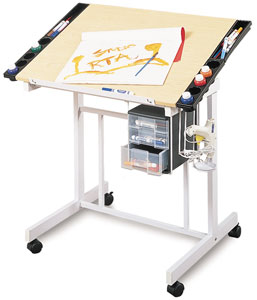
Studio Craft Station


Blog Design By Sour Apple Studio © All Rights Reserved.